NATURAL RESOURCES MINISTRY BLOCKED ROAD CONSTRUCTION AT HILL 450, HINDERING MILITARY REINFORCEMENTS
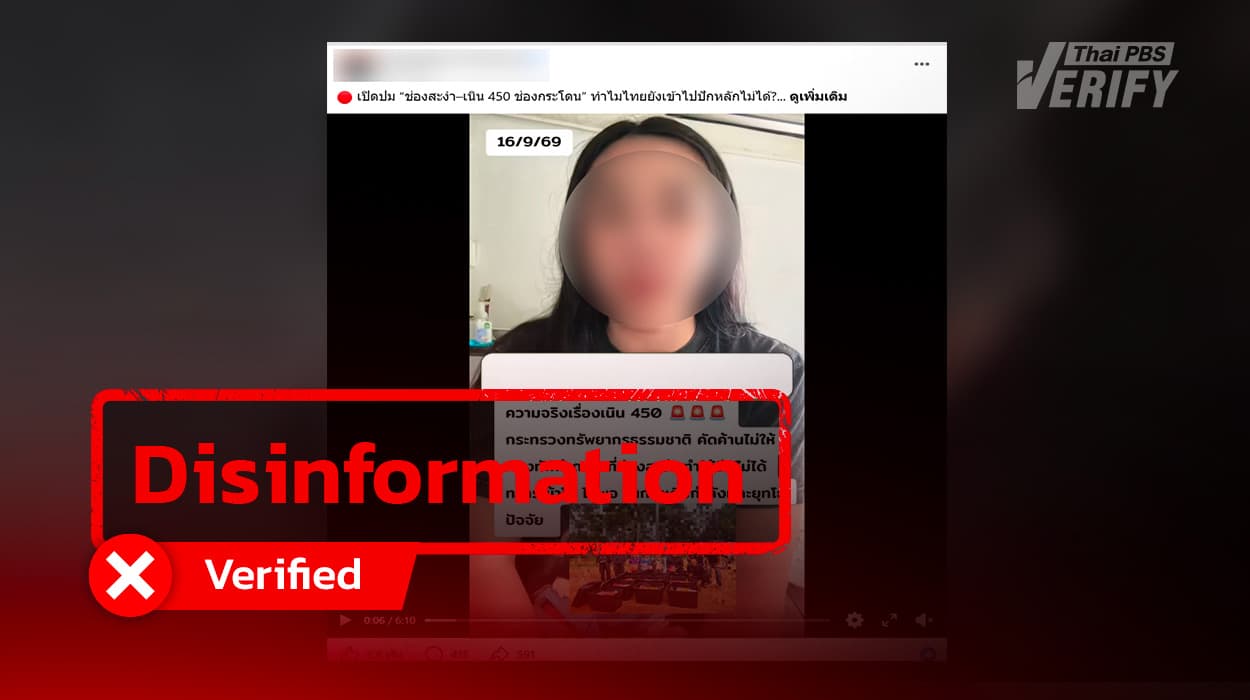
Thai PBS Verify traced the claim to a post on Facebook.
Thai PBS Verify found a Facebook account that had shared a video making the following claims:
“At Hill 450, where Hun Sen’s side reportedly had trenches dug and barbed-wire fences installed, does everyone know what happened? I want to explain what the real cause was.
As for Chong Sa-ngam, why didn’t we take better care of the area? Why did we allow the other side to move in like that?
The military has been doing its best. The Ministry of Defence tried to build roads so that troops could be deployed to guard various frontline areas. But they were unable to send enough troops there, allowing the other side to dig trenches and install barbed-wire barriers.
During the first and second rounds of fighting, we were unable to fully secure Chong Sa-ngam because there were too few infantry and ranger personnel to launch an assault. Apart from Gripen and F-16 aircraft, the most important forces needed to attack and secure the position are infantry and rangers.
At the time, there were too few infantry and rangers because there were not enough roads providing access to the area. As a result, we could not deploy enough troops to guard the position.
The main reason was that the Ministry of Defence had tried to build roads, but the Ministry of Natural Resources and Environment opposed road construction at Chong Sa-ngam. As a result, we could not properly defend the area. The troops could not reach it.
The journey through the forest is extremely difficult and time-consuming. To reinforce the position, large numbers of troops would have to be transported by vehicle. But vehicles cannot currently reach the area because the Ministry of Natural Resources did not approve the road construction.
The Ministry of Defence was trying to protect Chong Sa-ngam in the forest around Chong Kradon and Hill 450, but reaching the area was extremely difficult. We could not reinforce the troops.
In combat, if you do not have food, personnel or supplies, you lose. Troops need provisions, replacement personnel, ammunition and weapons. But resupply is difficult because there are no roads. Transporting supplies or traveling on foot can take an entire day.
I do not know which ministry has greater authority or what rules apply between the Ministry of Natural Resources and Environment and the Ministry of Defence. Why did this happen? What criteria were used to prevent road construction in the area?
When it comes to national security, however, adjustments can be made. Forests and nature can still be protected while allowing roads to be built for transporting supplies, just as roads exist in national parks. Building a road does not necessarily mean destroying nature. Sometimes national security also has to be taken into consideration.
I do not know how senior officials make these decisions or why the Ministry of Defence was prevented from building roads.
The major problem now is that Hun Sen’s side reportedly dug trenches to prevent tanks from entering the area and to establish and expand its position. Barbed-wire barriers were also installed.
The situation at Hill 450 around Chong Kradon needs to be addressed. Rangers are currently stationed in small, scattered positions, and there are not enough personnel to provide adequate reinforcement. If fighting breaks out, movement will be extremely difficult because troops would have to travel on foot.
I wanted to share this information with everyone. At present, senior officials from the Cambodian and Thai sides are holding talks, but there is still no conclusion about when the barbed wire will be removed or whether the trenches will be filled.
In Phnom Penh, senior officials are reportedly divided into two camps. Some want to prevent conflict, while others believe that complying with Thailand’s demands would cause Hun Sen to lose respect and undermine public confidence in him.”
The post also included the following caption:
“The truth about Hill 450: The Ministry of Natural Resources and Environment opposed the military’s construction of roads at Chong Sa-ngam, making it impossible to secure the area. There were not enough troops to reinforce personnel and military equipment.”
The poster also wrote that “Rung and Khun Ice” were urgently preparing ration packs and invited people to contribute, with bank-account details provided in the post and comments.
The post received 3,600 reactions, 415 comments and more than 591 shares.
Did the Ministry of Natural Resources and Environment Really Block Road Construction at Hill 450?
Thai PBS Verify searched for information using the keyword “Hill 450” and found a report published on September 17, 2026, titled “Protected Area Regional Office 9 Confirms It Never Opposed Tactical Road Construction at Hill 450, Chong Sa-ngam.”
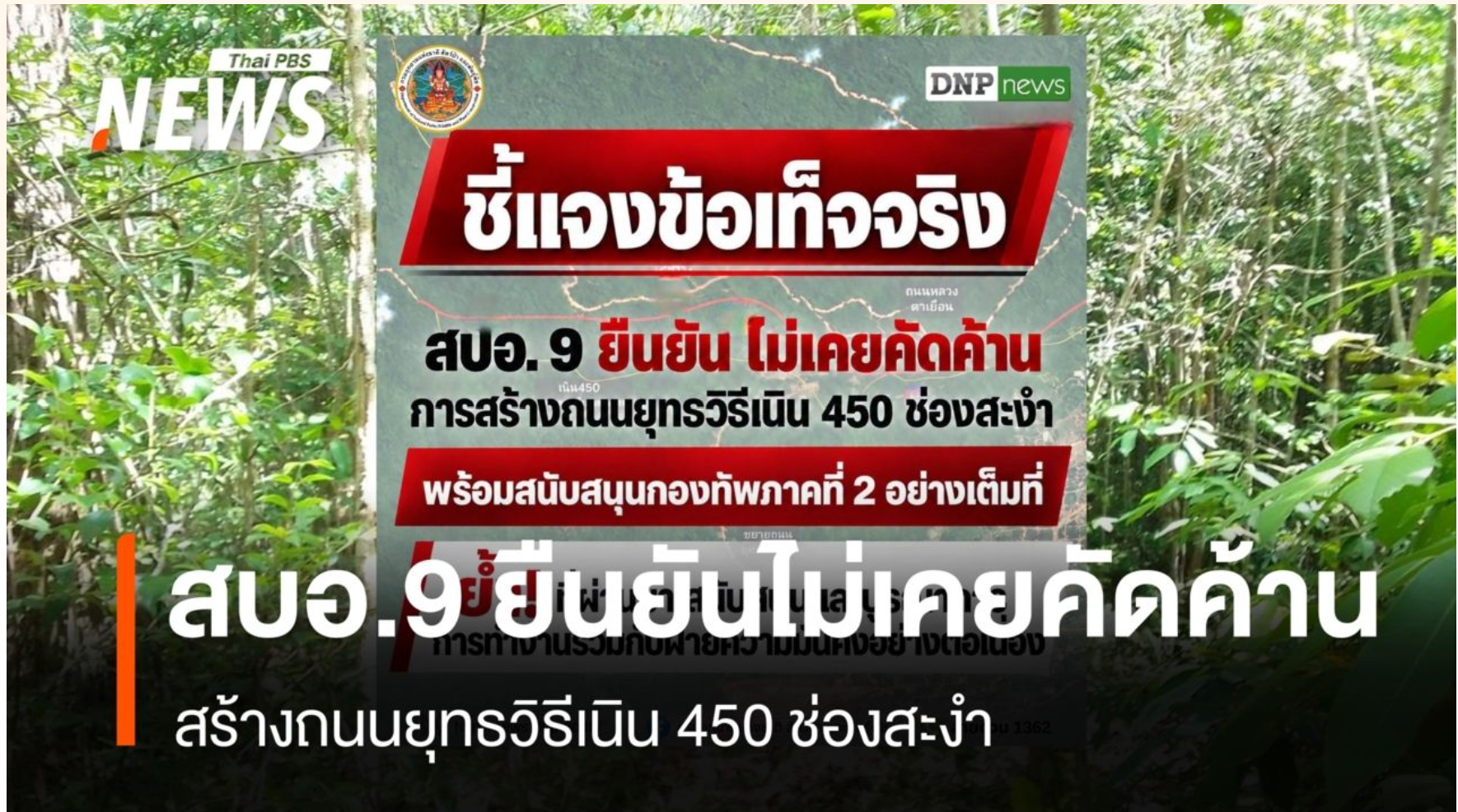
The Protected Area Regional Office 9 (Ubon Ratchathani), Department of National Parks, Wildlife and Plant Conservation, clarified that it had never opposed tactical road construction by security forces around Hill 450 in the Chong Sa-ngam area.
Mr. Pichai Watcharawongpaiboon, Director of Protected Area Regional Office 9, said an inspection found that Hill 450 is located within the Huai Thap Than–Huai Samran Wildlife Sanctuary in Bua Chet District, Surin Province, approximately 8 kilometers west of Chong Sa-ngam.
The route in the area was already included in the security sector’s operational plans. Security agencies had previously improved parts of nearby tactical routes between Border Markers 2 and 3, covering approximately 4 kilometers.
Protected Area Regional Office 9 said that if security forces had an urgent operational need to further improve tactical routes near Hill 450, the office and the heads of the relevant conservation areas were prepared to support the work and grant authorization immediately, without obstacles or objections.
Furthermore, all six conservation-area units under Protected Area Regional Office 9, which are responsible for areas along the Thai-Cambodian border in Surin, Sisaket and Ubon Ratchathani provinces, have continued to work with the Suranaree Task Force, the 2nd Army Area and other national-security agencies.
Their cooperation has included improving tactical and patrol routes for forest-resource protection. Protected Area Regional Office 9 said these operations had proceeded smoothly and that there had never been disputes or objections between the agencies.
Mr. Pichai said that protecting national sovereignty and security was important and must be carried out alongside forest conservation. He urged the public and the media to rely on information from official government channels and exercise caution before sharing false information that could affect national security or potentially violate the law.
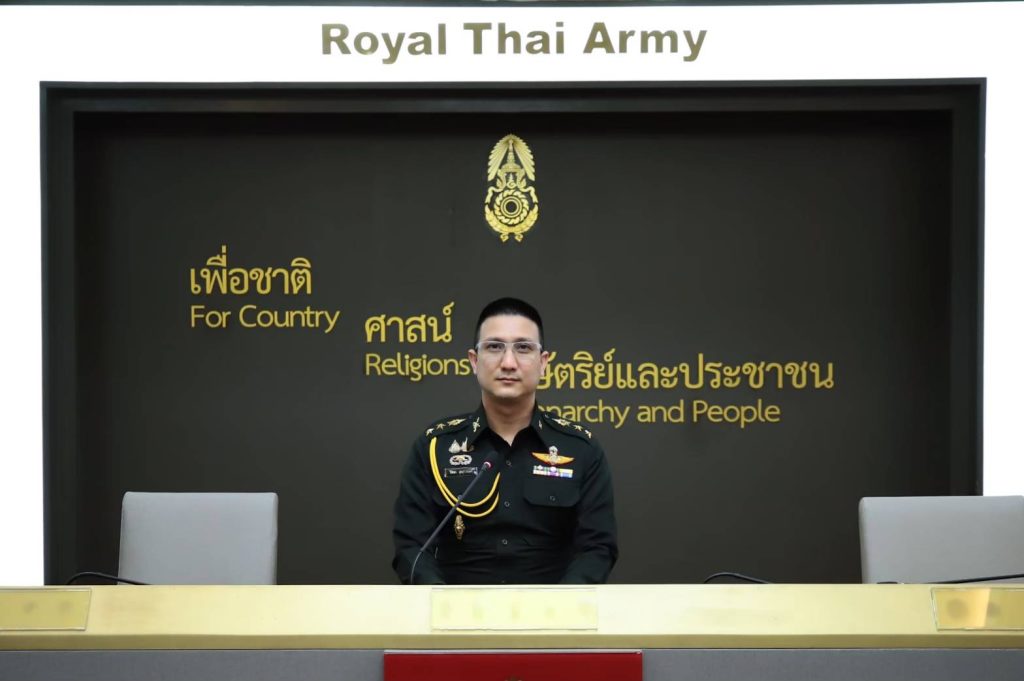
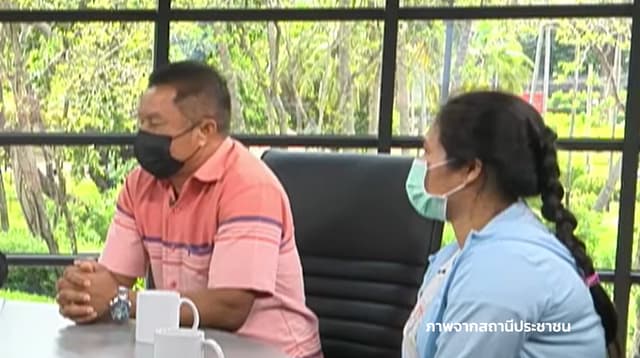
Col. Richa Suksuwanon, Deputy Spokesperson for the Royal Thai Army.
Meanwhile, Col. Richa Suksuwanon, Deputy Spokesperson for the Royal Thai Army, told Thai PBS Verify that the information was consistent with the statement issued by Protected Area Regional Office 9.
What Is the Current Situation?
On September 17, 2026, Maj. Gen. Winthai Suvaree, spokesperson for the Royal Thai Army, addressed reports that Cambodian troops had dug trenches and installed barbed-wire barriers near Hill 450 in the Chong Sa-ngam area of Phu Sing District, Sisaket Province.
He said Thai and Cambodian coordinating teams in the area had held discussions, after which the Cambodian side agreed to restore the trenches and barbed-wire barriers to their previous condition.
Administrative and military authorities continued to closely monitor the situation.
The Royal Thai Army said the situation was not considered alarming and urged the public to rely primarily on official government reports.
As for the reasons behind the digging of the trenches and installation of the barriers, no official report had been issued by local units. The Army also said that Cambodia’s agreement to restore the area could not yet be interpreted as an admission of encroachment on Thai sovereignty. Further details would need to be monitored through the relevant units on the ground.
What Are the Facts?
Thai PBS Verify examined the claim that the Ministry of Natural Resources and Environment had opposed the construction of tactical roads around Hill 450 in Chong Sa-ngam, thereby preventing the military from adequately delivering troops, supplies and military equipment to the area.
The claim was found to be inconsistent with the facts.
Protected Area Regional Office 9 (Ubon Ratchathani) confirmed that it had never opposed tactical road construction in the area. If security forces have an urgent operational need to improve additional routes, the office is prepared to support the work and grant the necessary authorization.
The Royal Thai Army also confirmed to Thai PBS Verify that the information was consistent with the clarification issued by Protected Area Regional Office 9.
Regarding reports that Cambodian troops had dug trenches and installed barbed-wire barriers at Hill 450, the Army said the Cambodian side had agreed to restore the area to its previous condition. However, there was still no official information confirming the reasons for the construction of the trenches and installation of the barriers.
The restoration of the area also cannot yet be interpreted as an admission of encroachment on Thai sovereignty.
Therefore, the claim linking difficulties in reinforcing troops to an alleged objection by the Ministry of Natural Resources and Environment to road construction is misleading and contradicted by statements from the relevant government agencies.
Verification Process
- Keyword Verification
Thai PBS Verify searched for information using the keyword “Hill 450.” The search found statements from Protected Area Regional Office 9 and the Royal Thai Army rejecting the circulating claim and confirming that there had been no objection to tactical road construction at Hill 450.
The conservation authorities also stated that they were prepared to support security agencies in improving border routes when necessary, while continuing to protect forest resources and national sovereignty.
- Source Verification
The Deputy Spokesperson for the Royal Thai Army confirmed the information to Thai PBS Verify and said it was consistent with the statement issued by Protected Area Regional Office 9.
The available information indicates that coordination between security agencies and conservation authorities in the border area has continued without the problems described in the circulating claim.
Impact of the False Information
- It may distort public understanding of the situation along the border, particularly regarding road construction and military operations around Hill 450 and Chong Sa-ngam.
- It may create misunderstandings about the roles of government agencies by giving the impression that Protected Area Regional Office 9 or the Ministry of Natural Resources and Environment is obstructing security operations, despite official statements that the agencies have never opposed such work.
- It may increase public concern about the border situation by portraying local tensions or inter-agency disagreements as more serious than the available facts indicate.
- Repeated dissemination of misleading information on social media may undermine public confidence in government agencies.
- It may lead to the continued circulation of unverified information, particularly claims about the reasons behind the digging of trenches and installation of barbed-wire barriers, which the Army said have not been officially confirmed.
What to do with this misinformation?
- Check the source to determine whether the information comes from a credible agency or individual.
- Cross-check with relevant authorities. Information about border developments should be compared with official announcements or statements issued directly by government agencies.
- Do not rush to believe or share unverified information when there is no clear evidence or authoritative source.
- Distinguish facts from assumptions, particularly when discussing the causes of incidents or developments that have not yet been officially confirmed.
- If false or misleading information is identified, alert others and provide reliable sources to help prevent further dissemination.
- Avoid sharing sensitive information that could affect national security or cause public panic unless it has been confirmed by the relevant authorities.